
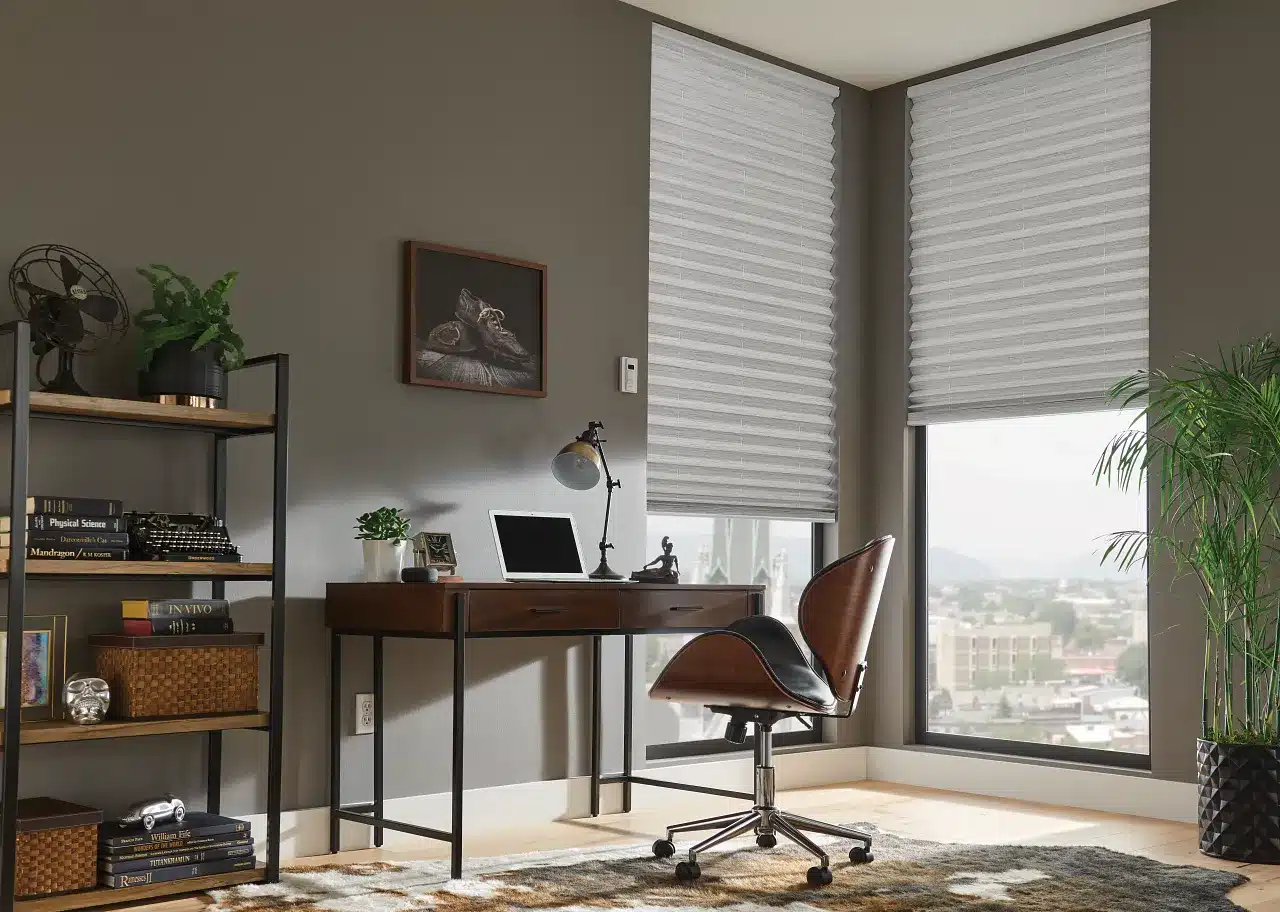
A comfortable home office needs more than a desk, chair, and reliable internet connection. Natural light can make a workspace feel open and welcoming, but uncontrolled sunlight can also reflect across computer monitors, create distracting shadows, and make it difficult to see what is on the screen. In some cases, employees and business owners respond by closing the blinds completely and working in a dark room, but that does not have to be the only solution.
Learning how to reduce screen glare in a home office begins with identifying where the light is coming from and selecting window treatments that provide adjustable control. Solar shades, roller shades, cellular shades, blinds, shutters, draperies, and motorized treatments can all help manage glare without eliminating natural light entirely.
Made in the Shade – Eastern Iowa helps homeowners in Iowa City, Davenport, Bettendorf, the Quad Cities, Cedar Rapids, North Liberty, Tiffin, and surrounding communities find treatments suited to their working environment. Through a complimentary in-home consultation, homeowners can compare materials, colors, opacities, and operating systems in the room where they will actually be used.
Why Screen Glare Is More Than a Minor Distraction
Glare occurs when bright light reflects from a computer monitor or creates a strong contrast between the screen and its surroundings. It can make text difficult to read, wash out colors, and obscure details during video editing, graphic design, financial work, or other screen-intensive tasks.
The position of the sun changes throughout the day, so a workspace that feels comfortable in the morning may become difficult to use in the afternoon. Seasonal changes also affect the angle and intensity of incoming light. A window that creates few problems in June may allow lower winter sunlight to shine directly across the desk in December.
People often compensate by leaning toward the screen, squinting, changing their posture, or increasing the monitor’s brightness. These temporary adjustments may make the screen easier to see, but they do not address the source of the problem. They can also make a long workday feel more tiring.
When considering how to reduce screen glare in a home office, the objective should be to create balanced illumination. The room should remain bright enough for comfortable work while direct sunlight and strong reflections are controlled.
Identify the Source of the Glare
Before choosing a window treatment, determine when and where glare occurs. Watch how sunlight moves through the office during the hours when the room is normally in use. The most effective solution may depend on whether the problem lasts all day or only appears for an hour or two.
A monitor positioned directly in front of a window may be surrounded by a bright background, forcing the eyes to adjust constantly between the darker screen and intense daylight. A monitor facing away from the window may reflect the glass and outdoor light. Windows located beside the desk can also cast sunlight across the display at certain times.
East-facing windows typically receive stronger morning light, while west-facing windows often produce intense afternoon sun. South-facing windows can experience extended daylight, and north-facing windows usually receive softer, more indirect illumination. Nearby buildings, trees, rooflines, and overhangs can modify these patterns.
Understanding how to reduce screen glare in a home office requires looking beyond the monitor itself. Window direction, desk placement, wall color, artificial lighting, and reflective surfaces can all influence the result.
Direct Glare Versus Reflected Glare
Direct glare occurs when bright sunlight or another intense light source enters the field of vision. Reflected glare appears when light bounces off the monitor, a glossy desk, glass artwork, polished furniture, or another surface.
A window treatment can address both issues by diffusing or blocking the incoming sunlight before it reaches the workspace. However, the treatment must offer the appropriate level of coverage. A very sheer material may soften the appearance of the window without reducing enough brightness for screen comfort, while an unnecessarily opaque material may make the office feel closed off.
Start With the Position of the Desk
Repositioning the desk can sometimes reduce glare before a new treatment is installed. Ideally, the computer monitor should sit at a right angle to the primary window. This arrangement helps prevent the window from appearing directly behind the screen or reflecting directly in front of the user.
Not every room offers enough flexibility to accomplish this. Electrical outlets, doorways, built-in shelving, heating vents, limited floor space, or multiple monitors may restrict the available desk positions. A home office may also double as a guest room, craft room, or homework space, making furniture placement more complicated.
Even when the desk can be moved, the sun’s changing angle may still create glare at certain times. Window treatments provide adjustable control that furniture placement alone cannot deliver.
For homeowners exploring how to reduce screen glare in a home office, desk positioning and window coverings should be considered together. A thoughtful combination can improve screen visibility while preserving an efficient and visually balanced layout.
Solar Shades for Glare and UV Control
Solar shades are one of the most practical choices for offices with strong sunlight. Their specialized fabrics are designed to reduce glare and ultraviolet exposure while maintaining some degree of outward visibility.
Unlike an opaque shade, a solar shade can preserve the connection to the outdoors. This can be appealing in an office overlooking a backyard, garden, neighborhood, or Eastern Iowa landscape. The view becomes more subdued, but it does not necessarily disappear.
Solar fabrics are available in different openness factors. The openness factor describes how tightly the material is woven and affects the amount of light and view that pass through it. A lower openness factor generally provides greater glare reduction and privacy, while a higher openness factor preserves more of the view.
Color also influences performance. Darker solar materials often provide clearer outward visibility and effective glare control. Lighter materials can reflect more heat and coordinate with pale interiors, although the view through the fabric may appear less distinct.
When deciding how to reduce screen glare in a home office, homeowners should evaluate solar samples at the actual window. The direction of the sunlight, the color of the fabric, and the openness factor all affect how the material performs.
Consider Evening Privacy
Solar shades are primarily designed for daytime sunlight management. At night, when interior lights are on and the exterior is dark, many solar fabrics do not provide complete privacy.
If the home office faces a street, neighboring house, or frequently used outdoor area, an additional privacy solution may be needed. Solar shades can sometimes be layered with drapery panels or another treatment. A dual-shade configuration may also pair a solar material with a more private room-darkening fabric.
The appropriate solution depends on whether the room is used only during business hours or also serves as an evening study, gaming room, or household office.
Roller Shades for Flexible Light Control
Roller shades offer a clean profile and a broad range of fabric opacities. They roll compactly at the top of the window, leaving the view largely unobstructed when open. When glare becomes a problem, the shade can be lowered to the necessary position.
Light-filtering roller shades soften harsh sunlight and distribute it more evenly through the room. This can reduce contrast around the monitor without making the office completely dark. Room-darkening fabrics provide stronger coverage for windows that receive intense direct sunlight.
In offices with several windows, homeowners may select different fabrics based on each window’s orientation. A room-darkening material might be appropriate for the west-facing window nearest the monitor, while a lighter fabric could be used on a north-facing window.
Roller shades are particularly useful when researching how to reduce screen glare in a home office with a modern or minimalist design. Their streamlined appearance does not introduce excessive visual detail, making it easier to maintain an organized and professional atmosphere.
Select the Right Fabric Opacity
Fabric opacity should correspond with the severity of the glare and the type of work performed in the room.
A light-filtering fabric is often sufficient for general computer use, email, administrative work, and online meetings. It diffuses sunlight while allowing the office to remain naturally bright.
A room-darkening material may be a better choice for video production, graphic design, gaming, photography editing, or work requiring accurate color perception. It can also help when the monitor is positioned near a particularly bright window and cannot be moved.
Room-darkening is not necessarily the same as complete blackout. Light may still enter around the edges of the treatment. A professional can explain how fabric, mounting style, window depth, and potential side channels affect overall coverage.
Cellular Shades for Diffused Light and Insulation
Cellular shades feature honeycomb-shaped pockets that trap air at the window. Their construction can help reduce heat transfer while their fabric softens incoming light.
This combination is valuable in a home office because comfort affects productivity. A desk positioned beside a large window may become noticeably warm on a sunny summer afternoon or cold during an Eastern Iowa winter. Cellular shades create an additional layer between the office and the glass.
Light-filtering cellular shades distribute sunlight throughout the room rather than allowing a concentrated beam to fall across the desk. Room-darkening versions offer greater glare control when stronger coverage is needed.
For homeowners learning how to reduce screen glare in a home office, cellular shades can address multiple concerns at once: glare, privacy, insulation, and overall visual comfort.
Top-Down, Bottom-Up Operation
Some cellular shades are available with top-down, bottom-up operation. This design allows the shade to lower from the top, raise from the bottom, or occupy a selected section of the window.
It can be especially useful when the strongest glare comes through the lower portion of the glass. The homeowner can cover the area aligned with the monitor while leaving the upper window open for natural light.
This configuration may also support privacy. In an office facing a sidewalk or neighboring property, the lower part of the window can remain covered while daylight enters above eye level.
Available operating options vary by product, window size, and configuration. These factors should be discussed during the consultation.
Sheer Shades for Soft, Adjustable Daylight
Sheer shades combine soft fabric with adjustable vanes. When the vanes are open, filtered light passes through the sheer material. When tilted closed, the treatment provides greater privacy and light control.
This adjustability allows homeowners to respond to changes in the sun without fully raising or lowering the treatment. The vanes can redirect light away from the monitor while the sheer fabric reduces harsh brightness.
Sheer shades bring a refined, finished appearance to a home office. They are well suited to spaces where the office is visible from another room or where the homeowner wants the workspace to coordinate with polished residential interiors.
When evaluating how to reduce screen glare in a home office, sheer shades are most appropriate when the goal is to soften and redirect daylight rather than create complete darkness.
The precise performance will depend on the fabric and vane position. Offices with extreme sunlight may require a more opaque or specialized glare-control material.
Blinds for Precise Directional Control
Horizontal blinds provide adjustable slats that can be tilted to redirect sunlight. This is particularly useful when the glare changes position throughout the day.
Instead of blocking the entire window, the homeowner can angle the slats upward or downward. This helps keep direct rays away from the screen while allowing indirect daylight to enter the room. Blinds can also be raised when full sunlight and an unobstructed view are desired.
Available materials may include wood, composite, faux wood, or other finishes. The right choice depends on the window size, moisture conditions, design preferences, and desired durability.
Blinds can be an effective answer to how to reduce screen glare in a home office when the homeowner values precise adjustment. Small changes to the slat angle can make a noticeable difference in screen visibility.
Proper fit is important. Blinds that are too narrow may allow bright strips of light along the sides, while an incorrect length can affect their appearance and operation.
Shutters for Lasting Light Management
Interior shutters use adjustable louvers to manage sunlight, privacy, and visibility. Their solid construction gives them an architectural appearance that works well in traditional, transitional, farmhouse, and contemporary offices.
Louvers can be tilted to direct sunlight away from the desk while maintaining some exterior visibility. Depending on the shutter configuration, separate sections may operate independently. This allows homeowners to cover the portion of the window creating glare while leaving another portion open.
Shutters are durable and easy to adjust throughout the day. They can also coordinate with shutters installed in nearby bedrooms, living areas, or shared spaces.
For homeowners considering a lasting approach to how to reduce screen glare in a home office, shutters provide light control without relying solely on fabric opacity. Their adjustable louvers make it possible to respond to changing daylight conditions.
The louver size, panel arrangement, divider rail placement, and frame style should be planned around the window and desk location. Professional measuring ensures that the shutters operate properly without interfering with furniture, trim, or nearby doors.
Draperies for Layered Glare Control
Draperies can soften a home office visually while adding another level of light control. Depending on the fabric and lining, they may gently filter sunlight or provide substantial room darkening.
A traversing drapery system allows the panels to cover the window fully when glare is strongest. At other times, the fabric can stack to the sides and leave the glass open.
Draperies are especially effective when layered with shades, blinds, or shutters. The primary treatment can handle everyday adjustments, while the draperies provide additional coverage during periods of intense sun. Layering also gives homeowners more freedom to introduce color, texture, or pattern.
For anyone researching how to reduce screen glare in a home office without sacrificing a warm, residential appearance, draperies offer a highly customizable option.
The amount of stacking space must be considered so that the open panels do not cover too much of the window. Rod or track placement also affects how successfully the draperies contain light around the edges.
Motorized Window Treatments for a Smarter Workspace
Home office conditions can change several times during the workday. A treatment that is perfect at 9 a.m. may need adjustment by noon, then again in the late afternoon. Motorization makes those changes easier.
Compatible shades or draperies can be controlled with a remote, wall control, app, or available smart-home integration. This is convenient when windows are located behind a large desk, above cabinetry, or in another hard-to-reach location.
Scheduled operation can help the office respond proactively to sunlight. A shade might lower shortly before direct afternoon sun reaches the monitor and reopen after the glare has passed. This allows the homeowner to remain focused instead of repeatedly leaving the desk.
Motorization can be particularly useful for offices with several windows. Multiple treatments may be adjusted together rather than operating each one individually.
Technology can simplify how to reduce screen glare in a home office by making regular light adjustments part of the workday routine. Available features depend on the selected product, power source, window size, and control system.

Use Multiple Treatments for Windows With Different Exposures
A home office with more than one window may require a customized approach. Windows on different walls receive sunlight at different times and intensities. Applying the same fabric and opacity to every opening may produce more coverage than one window needs and too little for another.
For example, a west-facing window beside the desk may require a low-openness solar shade or room-darkening roller shade. A north-facing window on the opposite wall might only need a light-filtering treatment. Coordinating colors can maintain a consistent appearance even when the performance materials differ.
Corner windows require careful planning because adjacent treatments may compete for mounting space. Bay windows and unusually shaped windows can also affect product selection.
An in-home consultation allows each window to be evaluated individually while maintaining a cohesive overall design.
Choose Colors That Support Visual Comfort
Color influences how a window treatment manages and reflects light. Very bright white surfaces can sometimes intensify perceived brightness, while extremely dark materials may create strong contrast if the surrounding room is pale.
Neutral shades, soft grays, warm whites, muted earth tones, and understated colors often work well in home offices because they create a calm background. However, the appropriate color depends on the wall finish, flooring, furniture, natural light, and desired atmosphere.
Solar shade color has an additional performance role. Darker solar fabrics tend to preserve a clearer outward view, while lighter colors can reflect more solar energy. Dual-sided materials may offer a light exterior-facing surface with a different interior color.
Fabric samples should be viewed at the office window during the time when glare is most severe. This provides a more accurate impression than evaluating a small swatch under artificial lighting.
Reduce Glare During Video Calls
Window light can affect more than the computer screen. It also influences how a person appears during video meetings.
Sitting with an uncovered window directly behind the desk can make the camera expose for the bright background, leaving the person’s face dark. Facing a strong window may create harsh highlights or cause the person to squint. Uneven side light can produce heavy shadows.
A light-filtering shade can diffuse daylight, creating softer and more consistent illumination. Adjustable treatments allow the homeowner to fine-tune the amount of light before a meeting.
The treatment should also create a professional-looking background. Clean roller shades, tailored cellular shades, shutters, or coordinated draperies can make the office appear more intentional during calls with clients and colleagues.
Coordinate Artificial and Natural Light
Window treatments are most effective when combined with appropriate artificial lighting. A dark room with one bright monitor can create its own uncomfortable contrast, even after window glare has been controlled.
Use ambient lighting to illuminate the room evenly. A task lamp can provide focused light for paperwork, while indirect lighting can reduce harsh differences between the screen and its surroundings. Avoid pointing lamps directly at the monitor.
The monitor’s brightness should correspond with the room. A screen that looks like a bright light source may be set too high for a dim office, while one that appears dull may not be bright enough for a sunlit space.
Window treatments allow natural light to be adjusted so that the screen, room, and task lighting work together. The objective is not simply to make the office darker; it is to create a balanced environment that remains comfortable for extended periods.
Remember Privacy and Security
A home office may contain computers, client information, financial documents, inventory records, or other sensitive materials. Privacy should be considered alongside glare reduction, especially when the room faces a street, sidewalk, or neighboring property.
Light-filtering materials may obscure the interior during the day, but their performance can change at night. Solar fabrics often become easier to see through when interior lights are on. Blinds and shutters need to be tilted or closed properly to limit outside views.
If evening privacy is important, consider room-darkening shades, shutters, closed blinds, lined draperies, or layered treatments. Motorized schedules can close compatible treatments at sunset, helping maintain privacy even when the homeowner is focused on work elsewhere in the house.
Professional Measuring Improves Performance
Small light gaps may be particularly noticeable in an office because a narrow beam of sunlight can fall directly across the monitor. Accurate measurements help the treatment provide appropriate coverage.
A professional will evaluate the width, height, depth, trim, handles, locks, and available mounting area. The consultation can also identify whether an inside or outside mount will provide better glare control.
An outside-mounted treatment may extend beyond the window opening to reduce light along the edges. An inside-mounted treatment offers a clean, integrated appearance but may allow more perimeter light depending on the window and product.
The right mounting choice depends on the office’s glare problem, the window construction, and the selected treatment. Professional installation helps ensure smooth operation and proper alignment.
Home Office Solutions for Eastern Iowa
Eastern Iowa homeowners experience dramatic seasonal changes in daylight. Low winter sunlight may reach farther into a room, while long summer days can create extended periods of brightness. Snow-covered landscapes can also reflect intense light through home office windows.
The appropriate treatment may differ among homes in Iowa City, Davenport, Bettendorf, the Quad Cities, Cedar Rapids, North Liberty, and Tiffin. Window direction, surrounding trees, neighboring buildings, and the home’s architecture all influence performance.
Made in the Shade – Eastern Iowa brings product samples directly to the home, making it easier to evaluate how to reduce screen glare in a home office under the room’s real lighting conditions. Homeowners can compare solar materials, opacity levels, operating systems, colors, and textures beside their desk and computer equipment.
In addition to blinds, shades, shutters, and draperies, Made in the Shade – Eastern Iowa offers motorization, exterior shades, and awnings. Exterior products may help manage sunlight before it reaches certain windows, while interior treatments provide adjustable privacy and light control inside the office.
Create a More Comfortable and Productive Workspace
The right home office treatment should control glare without making the space feel unnecessarily dark. Solar shades can preserve outdoor views, roller shades provide streamlined coverage, cellular shades add insulation, blinds and shutters redirect sunlight, and draperies support attractive layered designs. Motorization can make these solutions even easier to use throughout the day.
The most successful selection will account for the window’s orientation, the monitor’s position, the hours when the room is used, and the level of privacy required. It should also complement the office’s furnishings and the rest of the home.
If you are deciding how to reduce screen glare in a home office, Made in the Shade – Eastern Iowa can help you compare options during a complimentary in-home consultation. You will receive guidance based on your actual windows, lighting conditions, work habits, and design preferences.
Made in the Shade – Eastern Iowa proudly serves Iowa City, Davenport, Bettendorf, the Quad Cities, Cedar Rapids, North Liberty, Tiffin, and surrounding areas. Call 563-726-8040 to schedule your complimentary consultation and create a home office with comfortable light, improved privacy, and window treatments selected for the way you work.

