
Wood-look blinds remain a favorite for homeowners who want adjustable light control, familiar operation, and clean horizontal lines. Yet the choice is not as simple as selecting a color. Material affects weight, texture, moisture tolerance, allowable width, maintenance, and the way a blind looks in changing daylight. When comparing faux wood blinds vs real wood blinds, Eastern Iowa homeowners should consider the specific room, window dimensions, daily use, and desired finish before deciding.
Made in the Shade – Eastern Iowa brings samples and professional guidance directly to the home. That makes it possible to compare colors beside actual trim, evaluate slat textures at full scale, and identify installation conditions that are easy to miss when shopping from a small image. The company serves Iowa City, Davenport, Bettendorf, the Quad Cities, Cedar Rapids, North Liberty, Tiffin, and surrounding areas.
Understanding the Two Materials
Both blind types use horizontal slats that tilt to control light and privacy. Both can be raised to uncover the glass, and both are available in colors suited to many interior styles. Their shared shape, however, can hide important differences in construction and performance.
Real wood blinds are manufactured from natural wood. Depending on the collection, they may be painted or stained to highlight the grain. Wood species, slat thickness, finishing methods, and color choices vary by manufacturer.
Faux wood blinds are made from engineered materials intended to imitate the appearance of painted or stained wood. Some use vinyl-based construction, while others incorporate composite materials or reinforced components. The category is broad, so one faux wood product may differ meaningfully from another in weight, rigidity, texture, and available sizes.
The central question in faux wood blinds vs real wood blinds is not which category wins in every situation. It is which product’s characteristics best match the window and room where it will be installed.
Appearance: Natural Character or Consistent Finish?
Visual preference often starts the conversation. Real wood offers grain patterns and subtle variation that are difficult to reproduce exactly. Even painted wood can retain a natural warmth and depth, especially when viewed up close. Stained finishes showcase the material more directly and can coordinate with flooring, cabinetry, furniture, beams, and other millwork.
Faux wood typically provides a more uniform appearance. Painted options can look crisp and consistent across several windows, while embossed textures may suggest natural grain. Improvements in manufacturing have made many faux wood products attractive, but the impression depends on the specific collection rather than the category name alone.
When reviewing faux wood blinds vs real wood blinds, look at samples in both daylight and artificial light. Move several feet away, then examine them from the normal seating or standing position in the room. A difference that seems obvious when holding samples inches from the face may become subtle once the blinds are installed.
Painted Finishes
White, cream, gray, and other painted neutrals are widely used because they coordinate easily with trim. Still, “white” is not one universal color. A cool white blind may make warm trim appear yellow, while a creamy blind can look dull beside a bright white casing. Undertones become more noticeable when large surfaces sit directly next to each other.
Faux wood products often provide highly consistent painted color. Real wood products may show slight variations that reflect the underlying material and finishing process. Neither effect is automatically better; the surrounding architecture and desired degree of uniformity should guide the choice.
Stained and Wood-Grain Looks
For a richly natural appearance, real wood is often the strongest candidate. Grain and color variation can give the blind furniture-like character. Faux wood collections may offer convincing wood-grain colors, but homeowners should inspect the repeating pattern, sheen, and texture at full scale.
In rooms with genuine wood trim, an exact match is not always necessary or possible. A complementary stain may look more intentional than a near match with a noticeably different undertone. Samples should be compared vertically at the window because horizontal lighting can alter how a finish appears.
Weight and Window Size
Weight is one of the most practical differences between the materials. Natural wood is generally lighter than many faux wood constructions of comparable size. That can make real wood blinds easier to raise on larger windows and may allow broader single-blind applications within manufacturer limits.
Faux wood blinds can become heavy as width and height increase. A large blind may require more effort to lift, place more stress on operating components, or exceed the size limits of the chosen product. Dividing a wide opening into two or three blinds may improve usability while aligning the sections with window mullions.
This part of faux wood blinds vs real wood blinds should be evaluated with exact measurements. A material that works beautifully on a standard bedroom window may not be the most practical choice for a broad living-room opening. Slat size, headrail construction, control type, and the number of blinds all affect the finished plan.
When Multiple Blinds Make Sense
Installing multiple blinds on one wide window can reduce weight per unit and allow sections to operate independently. This is useful when one side of the window needs glare control while the other remains open. The divisions should follow the window’s architecture so the headrails, lift controls, and vertical gaps look deliberate.
Multiple blinds also create additional light gaps and controls. Homeowners should weigh the benefit of easier operation against the desire for a single, uninterrupted treatment. A professional measurement can clarify which configurations are available and how each will look.
Moisture, Humidity, and Room Placement
Natural wood responds to moisture and changing environmental conditions. Repeated humidity or direct water exposure can affect its finish, shape, or long-term stability. For that reason, real wood is generally chosen with caution in bathrooms, laundry rooms, and other moisture-prone locations.
Many faux wood products are designed to tolerate humidity and occasional moisture more effectively. This makes them a frequent consideration for full bathrooms, busy kitchens, and laundry areas. However, moisture-resistant does not mean indestructible or suitable for constant soaking. Product specifications should be checked for the exact location.
For humid rooms, the balance in faux wood blinds vs real wood blinds often favors an appropriate faux wood product. Ventilation, distance from sinks or showers, window condensation, and cleaning habits still matter. Water should not be allowed to sit on slats, headrails, cords, or hardware.
Eastern Iowa’s Seasonal Conditions
Eastern Iowa homes experience humid summers, cold winters, and large seasonal temperature changes. During winter, warm indoor air can meet cold window glass and create condensation. A closed blind can reduce airflow near the glass, which may allow moisture to linger.
No blind can correct a window, insulation, or ventilation problem. Persistent condensation should be addressed directly. Homeowners can also help by using exhaust fans, maintaining reasonable indoor humidity, and opening blinds periodically to support airflow when conditions allow.
Light Control and Privacy
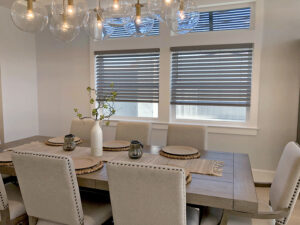
Both real and faux wood blinds provide adjustable light control through tilting slats. Louvers can be angled to redirect sunlight, reduce glare, or limit sightlines without raising the entire blind. At night, fully closing the slats increases privacy, although small light gaps between slats and around the blind are normal.
Slat size influences the view. Wider slats create fewer horizontal lines and may provide a broader outward view when open. Narrower slats have a more detailed appearance and may suit smaller windows or traditional room proportions. Available sizes vary by product.
In the everyday performance of faux wood blinds vs real wood blinds, the two categories can feel similar when they share the same slat size and operating system. The greater differences are often material weight, finish, allowable dimensions, and room suitability.
Direction of Tilt
Tilting slats upward or downward changes both light direction and privacy. The best angle depends on window height, sun position, and exterior sightlines. Street-facing rooms may benefit from a different slat position than second-floor windows overlooking a private backyard.
Homeowners should remember that daytime privacy does not guarantee nighttime privacy. After dark, interior lights make it easier to see through any incomplete closure. Evaluate the blind from outdoors at night if privacy is especially important.
Durability and Long-Term Performance
Durability is influenced by much more than the words “wood” or “faux wood.” Quality of construction, slat thickness, reinforcement, headrail components, installation, window size, frequency of use, environment, and care all matter.
Real wood blinds can provide years of performance in appropriate dry interior spaces. Because natural wood is relatively light, it may place less lifting strain on some larger installations. The finish should be protected from excessive moisture and harsh cleaning products.
Faux wood blinds are valued for their stability and moisture tolerance, but heavier slats can affect operation on large windows. Lower-quality products may be more vulnerable to sagging, discoloration, or mechanical wear. Comparing warranties and product specifications is more useful than assuming every item within a category performs identically.
The durability question in faux wood blinds vs real wood blinds should therefore be product-specific. Ask what material is used, how large the blind can be, whether reinforcement is included, what the manufacturer recommends for the room, and what care is required.
Cleaning and Maintenance
Both blind types collect dust on horizontal surfaces. Regular light cleaning prevents buildup and is usually easier than infrequent deep cleaning. Close the slats in one direction, dust gently, then reverse them to reach the opposite side.
Real wood should be cleaned according to manufacturer guidance. A soft microfiber cloth, duster, or low-suction vacuum attachment may be appropriate. Avoid saturating the wood or using abrasive and harsh chemical products that could damage the finish.
Faux wood slats may allow gentle damp cleaning, depending on the product, but the headrail and operating components should not be soaked. Dry the slats and hardware after cleaning. For greasy residue near cooking areas, use only an approved method.
If simple maintenance is a leading priority in faux wood blinds vs real wood blinds, ask to see care instructions before making the final selection. A finish that hides light dust or fingerprints may also be practical in busy rooms.
Cost and Overall Project Value
Real wood blinds commonly carry a higher initial price because of the natural material and finishing process. Stains, specialty paints, decorative valances, and larger sizes can influence cost. Faux wood often offers the wood-blind look at a more accessible price point, making it attractive for multi-room projects.
Price should be considered together with fit and room suitability. In faux wood blinds vs real wood blinds, choosing natural wood for a humid location may be a poor value if the environment conflicts with the product, while selecting a very heavy faux wood blind for an oversized window may create inconvenient operation. The least expensive line item is not necessarily the most satisfying installed solution.
Homeowners should compare the complete project: material, controls, number of blinds, valances, measuring, installation, warranty, and expected use. A consultation can reveal when using one material in main living areas and another in moisture-prone rooms creates a better whole-home plan.
Sustainability and Material Priorities
Environmental considerations are complex. Real wood is a natural material, but sourcing, forestry practices, transportation, manufacturing, finishing, product longevity, and eventual disposal all influence its impact. Faux wood may incorporate synthetic or composite components, with environmental characteristics that vary by manufacturer and collection.
Homeowners who prioritize sustainability should ask specific questions rather than relying on general assumptions. Available certifications, material disclosures, manufacturing practices, recycled content, packaging, and product lifespan may help inform the decision. The most suitable option is one that performs well enough to avoid premature replacement.
Cordless Controls and Daily Operation
Modern blind controls vary. Depending on the product and dimensions, choices may include cordless lift, wand tilt, traditional controls where permitted, or other operating systems. Availability should be confirmed for the exact blind rather than assumed from a general sample.
Cordless lift creates a clean appearance and removes dangling lift cords. The bottom rail is raised or lowered by hand, so the window must remain accessible. On a heavy blind, daily lifting effort is an important consideration. High or blocked windows may require a different product strategy.
When discussing faux wood blinds vs real wood blinds, try the controls on full-size samples if possible. Consider who will operate the blind, how often it will be raised, and whether furniture or counters restrict access. A blind that is left at one height and adjusted mainly by tilting has different demands from one raised every morning.
Room-by-Room Recommendations
Different rooms can justify different materials even within the same home. Coordinating slat size, valance style, and color can create continuity without forcing one construction into every environment.
Living Rooms and Family Rooms
Main gathering spaces often benefit from the warmth and refined grain of real wood, particularly when blinds coordinate with flooring, furniture, ceiling beams, or traditional millwork. Painted faux wood can work equally well when uniform color, moisture tolerance, or budget is more important.
Large windows deserve special attention. Exact dimensions may determine whether a single blind is practical or whether multiple blinds will operate better. Consider how the divisions align with window frames and the positions from which outdoor views are most often enjoyed.
Bedrooms
Both materials provide strong adjustable privacy for bedrooms. Color, weight, window size, and desired finish may drive the decision. Closed slats reduce light substantially, but blinds do not create complete blackout because light can enter between slats and around the edges.
Homeowners who are sensitive to morning light should discuss realistic expectations and possible layering. The selected solution should also allow convenient access to window locks and meet household safety needs.
Kitchens
Kitchens can expose blinds to humidity, splashes, grease, and frequent cleaning. An appropriate faux wood product is often practical, especially near sinks or busy preparation areas. Natural wood may still suit a kitchen window located away from moisture when ventilation and care are appropriate.
Faucets, backsplashes, cabinets, and counters affect mounting and operation. A blind over a sink may be easy to tilt but awkward to raise. Control placement and cleaning access should be considered during measuring.
Bathrooms and Laundry Rooms
These rooms usually strengthen the case for moisture-tolerant faux wood. Product guidance remains important, especially near direct water. Natural wood should not be selected solely to match a vanity if the environment is likely to challenge the material.
Home Offices
Both materials can control screen glare and create a polished background for video calls. Real wood may contribute warmth and an executive feel, while painted faux wood can keep the room bright and streamlined. Slat position can be adjusted as the sun moves throughout the workday.
For home offices, faux wood blinds vs real wood blinds often comes down to aesthetic preference, window size, and budget because moisture is usually less important than in kitchens or bathrooms.
Sunrooms and High-Sun Exposures
Rooms with intense sunlight deserve careful product evaluation. Heat, ultraviolet exposure, and wide temperature shifts can affect colors and materials over time. Ask about finish performance, recommended exposure, and product limitations. Exterior shading may also help manage strong solar heat before it reaches the glass.
Made in the Shade – Eastern Iowa offers exterior shades and awnings in addition to interior window treatments, allowing homeowners to consider how indoor and outdoor solutions can work together where appropriate.
Coordinating Blinds Throughout an Open Floor Plan
Open-concept homes create long sightlines across kitchens, dining areas, and living spaces. Window treatments do not need to match every cabinet or furniture finish, but they should relate intentionally. A common slat color and valance profile can unify windows even when different materials are used in specific rooms.
For example, faux wood may be selected near the kitchen sink while real wood is used in a connected living area. If the colors coordinate closely, the transition may feel seamless. If an exact match is not available, a deliberate complementary finish can look better than two almost-identical tones.
Review samples from multiple positions and at different times of day. Eastern and western light can shift undertones, while evening bulbs may make the same finish appear warmer. The in-home setting is the best place to judge that relationship.
Common Shopping Mistakes
One frequent mistake is assuming all faux wood blinds are the same. Materials, weight, reinforcement, texture, color stability, and operating limits vary. Compare named products and specifications rather than category labels alone.
Another mistake is choosing by a tiny color chip. Blinds contain many horizontal slats, so the installed color has much more visual impact than a handheld sample suggests. Full-size samples provide a clearer sense of texture, sheen, and scale.
Homeowners may also overlook weight. A faux wood blind that feels manageable in a small showroom sample can become substantially heavier across a large opening. Exact measurements and product limits should shape the design.
Finally, do not assume real wood belongs in every high-end room or faux wood only in utility spaces. The right answer in faux wood blinds vs real wood blinds is based on performance and design together. A quality faux wood product can look polished, while real wood adds little value if the environment is unsuitable.
Questions to Ask During a Consultation
A professional consultation should clarify the tradeoffs rather than simply present colors. Ask:
- What is the exact composition of the faux wood product?
- Which material is recommended for this room, and why?
- How does the weight differ at the measured window size?
- Can one blind span the opening, or should it be divided?
- Which slat sizes and finishes are available?
- How will the color coordinate with existing trim and cabinetry?
- Is the product approved for humid rooms?
- What light gaps should be expected?
- Which cordless or other control options are available?
- Can the blind be raised comfortably from its installed position?
- What cleaning method does the manufacturer recommend?
- What product and installation warranty information applies?
Clear answers make it easier to compare complete solutions rather than isolated samples.
Local Guidance for Eastern Iowa Homes
Homes across Eastern Iowa include historic properties, mid-century neighborhoods, rural residences, townhomes, and new construction. Window sizes, trim details, humidity conditions, and design priorities can vary substantially from one property to the next.
In Iowa City, North Liberty, and Tiffin, a homeowner may be coordinating blinds with contemporary open-plan finishes or recently installed windows. In Cedar Rapids, Davenport, Bettendorf, and communities throughout the Quad Cities, projects may involve established millwork, remodeled rooms, or wide picture windows. An in-home consultation allows recommendations to reflect those actual conditions.
For local homeowners considering faux wood blinds vs real wood blinds, Made in the Shade – Eastern Iowa provides custom measurement, product guidance, and professional installation. The company also offers shades, shutters, draperies, motorization, exterior shades and awnings, allowing each room to receive the type of treatment that fits it best.

How to Make the Final Choice
Begin with the room. If humidity and frequent cleaning are central concerns, an appropriate faux wood product may be the stronger option. If natural grain, lighter weight, and furniture-like warmth are priorities in a dry room, real wood may justify its higher cost.
Next, evaluate the window. Width, height, depth, hardware, and access influence how the blind should be configured. A preferred material may need to be divided into multiple units, or another product may work better on an unusually large opening.
Finally, compare the samples in context. Examine finish, texture, weight, controls, valance, and warranty information. Think about how often the blind will be raised, who will operate it, and how the room’s conditions change throughout the year.
There is no universal winner in faux wood blinds vs real wood blinds. The most successful choice is the one that fits the environment, operates comfortably, supports the design, and meets the homeowner’s expectations for care and budget.
Schedule a Complimentary In-Home Consultation
If you are weighing faux wood blinds vs real wood blinds, Made in the Shade – Eastern Iowa can help you compare full-size samples in your home. A professional can measure the windows, explain material and operating differences, evaluate moisture or size concerns, and help coordinate colors with existing finishes.
Made in the Shade – Eastern Iowa serves Iowa City, Davenport, Bettendorf, the Quad Cities, Cedar Rapids, North Liberty, Tiffin, and surrounding areas. Explore custom blinds along with shades, shutters, draperies, motorization, exterior shades and awnings during a free, no-pressure consultation.
Call 563-726-8040 to schedule your complimentary consultation.

