
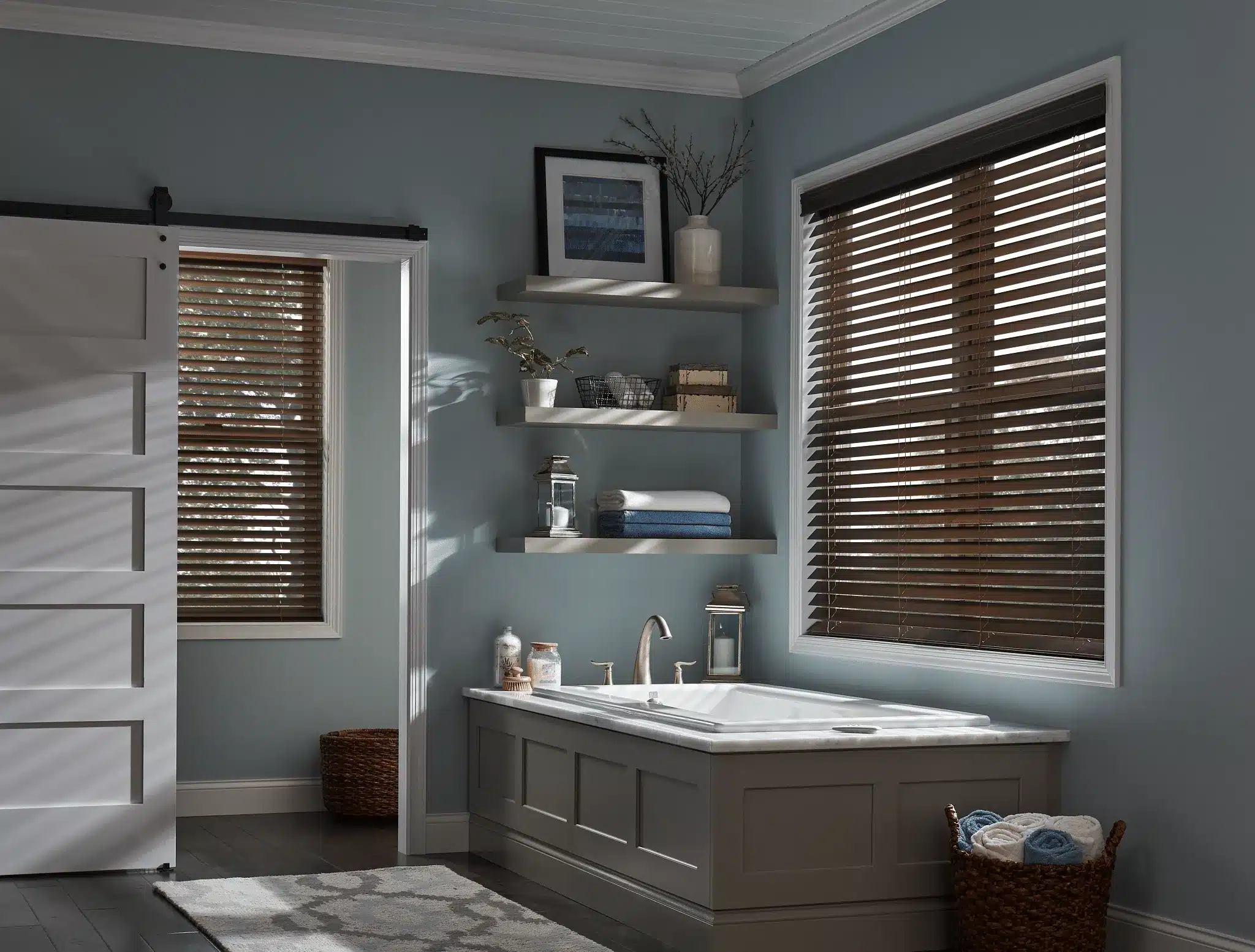
Bathrooms ask more of window treatments than almost any other room. A covering may need to protect privacy at all hours, admit comfortable daylight, tolerate changing humidity, operate around tile or fixtures, and still contribute to a polished design. For homeowners comparing the best window treatments for bathrooms, the right answer depends on the window’s location, the room’s ventilation, the level of moisture exposure, and how much privacy is needed from nearby homes or streets.
Made in the Shade – Eastern Iowa helps homeowners make those decisions in the room itself. During a complimentary in-home consultation, samples can be viewed beside tile, cabinetry, flooring, paint, and existing trim. The company serves Iowa City, Davenport, Bettendorf, the Quad Cities, Cedar Rapids, North Liberty, Tiffin, and surrounding Eastern Iowa communities, providing custom blinds, shades, shutters, motorization, exterior shades and awnings, and other tailored window treatment solutions.
Why Bathroom Windows Need a Specialized Approach
A bathroom can shift from cool and dry to warm and humid within minutes. Shower steam, splashes, condensation, hair products, cleaning supplies, and limited ventilation can all affect materials over time. A window covering that performs beautifully in a living room may not be the most practical choice beside a tub or shower.
Privacy is equally important. Some bathrooms face a private backyard, while others overlook a sidewalk, driveway, neighboring window, or closely spaced property. The best window treatments for bathrooms address these real viewing angles, because a second-floor location does not automatically guarantee privacy when hills, decks, nearby buildings, and nighttime lighting change the sightline.
The best window treatments for bathrooms account for both the interior environment and exterior view. They should provide the desired coverage without making the room unnecessarily dark. They also need to fit the opening accurately, clear locks and handles, and remain convenient enough to adjust every day.
Start by Studying the Window’s Location
Before selecting a style or color, consider exactly where the window sits. Distance from water, height above the floor, direction of exposure, and proximity to neighboring properties all influence the recommendation.
Windows Inside or Beside a Shower
A window located within a shower enclosure receives direct moisture and may be exposed to water repeatedly. This is a more demanding environment than a window across the room. Product suitability should be confirmed carefully, including the material, hardware, finish, mounting surface, and manufacturer guidance.
Even moisture-tolerant products need reasonable care. Water should not be allowed to collect around frames, brackets, sills, or operating components. Effective ventilation and routine drying help support the performance of the entire room, including the window, wall finishes, and window covering.
Windows Above a Bathtub
Tub windows may not receive the same direct spray as shower windows, but they can still experience humidity and occasional splashes. Reaching the covering can also be awkward, particularly above a deep soaking tub. A simple operating method—or compatible motorization where appropriate—can make the window easier to manage safely.
Windows Near a Vanity
Vanity windows are generally easier to access, though faucets, mirrors, sconces, backsplashes, and countertop items can restrict movement. The covering should open and close without hitting nearby fixtures. Materials should also be easy to maintain in a room where cosmetics, sprays, and water droplets are common.
High or Specialty-Shaped Windows
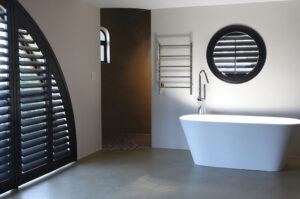
High windows may deliver useful daylight with naturally protected sightlines, but their height can make adjustment difficult. Arches, circles, angles, and narrow openings introduce additional measuring and product-selection considerations. Custom solutions can preserve architectural interest while addressing the degree of privacy the room actually needs.
How Much Privacy Does Your Bathroom Require?
Privacy is not a single yes-or-no feature. It changes according to fabric opacity, louver angle, slat position, mounting method, time of day, and the difference between indoor and outdoor lighting.
During daylight, some light-filtering materials appear private from inside. After dark, however, a brightly lit bathroom can reveal silhouettes or interior details. Homeowners should evaluate products for nighttime conditions, not only how a sample looks in afternoon sun.
When identifying the best window treatments for bathrooms, consider the view from every likely exterior angle. Stand near the street, side yard, deck, or neighboring sightline when practical. Inside the bathroom, consider whether someone using the tub, shower, vanity, or toilet requires coverage at a different height than a person standing near the doorway.
Split operation can sometimes help. Shutters with separately controlled louver sections, top-down/bottom-up shade configurations where available, or adjustable blinds may preserve daylight above while providing more coverage below. Product features and suitability vary, so the desired function should be discussed before ordering.
Bathroom Blinds: Adjustable and Familiar
Blinds offer familiar operation and precise adjustment through tilting slats. Homeowners can angle the slats to limit direct views while allowing light to filter between them. Raising the blind can expose the entire window when full daylight or access is wanted.
Faux Wood Blinds
Faux wood blinds are often considered for bathrooms because many products are designed to resist moisture better than natural wood. Their horizontal slats provide a classic appearance and coordinate easily with painted trim, cabinetry, and popular bathroom finishes.
The material does not make every faux wood blind identical. Slat construction, reinforcement, color, texture, headrail design, and allowable width vary among products. Wide bathroom windows may require multiple blinds or a divided arrangement to maintain practical operation and a balanced appearance.
For homeowners who prefer crisp horizontal lines, faux wood blinds may be among the best window treatments for bathrooms that are humid but not subject to constant direct soaking. The selected product’s specifications should guide placement, particularly close to showers.
Aluminum Blinds
Aluminum blinds have slim slats and a light visual profile. They offer strong tilt control and are available in a variety of finishes. Their streamlined construction can suit compact bathrooms or contemporary spaces where a heavier wood-grain look would feel out of place.
Slats should be handled gently to avoid bending, and cords or operating systems should be chosen with household safety and convenience in mind. A professional can explain available lift options and how the headrail will fit within the window opening.
Bathroom Shades: Soft Light and Design Flexibility
Shades create a broad surface at the window rather than a series of adjustable slats. Their performance depends heavily on material and opacity. Some diffuse sunlight, some preserve a partial outward view, and others provide stronger room darkening and privacy.
Roller Shades
Roller shades have a simple profile and can be made from many materials, including options intended for easier maintenance or moisture-prone settings. When raised, they occupy relatively little visual space. When lowered, they present a clean, uninterrupted surface that can support either a subtle neutral design or a stronger decorative statement.
Opacity deserves careful attention. A translucent material may soften daylight beautifully but provide less nighttime privacy than expected. A more opaque fabric can offer stronger coverage, though small light gaps may remain at the sides of an inside-mounted shade.
For streamlined rooms, roller shades are often considered among the best window treatments for bathrooms because they combine a clean shape with varied light-control choices. The correct fabric should be selected for the bathroom’s moisture conditions rather than appearance alone.
Cellular Shades
Cellular shades use a honeycomb-like structure that creates soft folds across the window. They can offer useful insulation at the glass and are available in multiple opacity levels. Certain products offer top-down/bottom-up operation, allowing homeowners to lower the upper portion for daylight while keeping the bottom covered.
Not every cellular fabric is appropriate for every bathroom location. Persistent humidity can affect textile-based products, particularly when ventilation is limited or the shade remains damp. A consultation should consider the distance from water, airflow, window condensation, and manufacturer recommendations.
Roman Shades
Roman shades introduce fabric, folds, and a tailored softness that can elevate a powder room or spacious primary bathroom. They are especially appealing when the bathroom design includes upholstered elements, patterned tile, or decorative finishes that benefit from a coordinated textile.
Because fabric can absorb moisture and odors, Roman shades are generally better suited to well-ventilated rooms and windows positioned away from direct splashes. The fabric content, lining, construction, and cleaning instructions should be reviewed carefully. A powder room without a shower creates a very different environment from a small full bathroom used by several family members each day.
Woven Shades
Woven materials bring natural-looking texture and warmth to a bathroom. Their open construction may require a privacy liner, especially at night. As with Roman shades, the room’s humidity and the window’s distance from water matter. Woven shades can be a beautiful design choice in suitable powder rooms or larger bathrooms with good ventilation.
Interior Shutters: Architectural Privacy and Control
Interior shutters are fitted to the window and use adjustable louvers within hinged panels. They can provide a built-in appearance that relates naturally to trim, cabinetry, and doors. By changing the louver angle, homeowners can redirect daylight and reduce exterior sightlines without raising the entire covering.
Composite or engineered shutter materials may be recommended for moisture-prone rooms, depending on the specific product. Natural wood requires more caution in humid or wet environments. Homeowners should ask why a particular material is being proposed and whether the manufacturer approves it for the intended location.
For many homeowners, shutters rank among the best window treatments for bathrooms because they combine privacy, light control, and substantial architectural style. They are particularly useful when separately controlled upper and lower louver sections can preserve daylight while screening the most sensitive portion of the room.
Frame depth and panel swing need careful planning. Window cranks, locks, tile returns, faucets, towel bars, mirrors, and adjacent walls can interfere with operation. Professional measurement helps ensure that the panels open properly and that the window remains accessible.
What About Draperies in a Bathroom?
Draperies can add softness, color, pattern, and a luxurious visual frame around a bathroom window. They may be considered in spacious primary bathrooms, dressing areas, or powder rooms where fabric remains well away from direct water and where ventilation is effective.
Full-length panels are not practical beside every tub, vanity, or toilet. Floor contact, limited wall space, and frequent moisture can create maintenance concerns. In a suitable room, stationary decorative panels may be paired with a more functional blind, shade, or shutter that handles everyday privacy.
When draperies are included among the best window treatments for bathrooms, fabric selection and placement are critical. Washable or easy-care characteristics may be valuable, while delicate materials can require professional cleaning. The design should keep fabric clear of wet surfaces and allow air to circulate.
Motorization for Hard-to-Reach Bathroom Windows
Motorization can make sense when a bathroom window is high, positioned above a deep tub, or blocked by a wide counter. Depending on the compatible product, homeowners may operate the covering with a remote, wall control, app, smart-home system, or programmed schedule.
The main benefit is convenient access. A shade that is difficult to reach may remain closed all day, sacrificing natural light, or open all night, sacrificing privacy. In hard-to-reach locations, motorization can help turn an appropriate product into one of the best window treatments for bathrooms by making it usable without stretching across a slippery or awkward area.
Power options may include batteries, rechargeable systems, plug-in power, or hardwiring. The appropriate choice depends on access, nearby outlets, construction stage, product specifications, and how future charging or battery replacement will be handled. Electrical components must be planned with the bathroom environment and applicable requirements in mind.
Automated schedules can close a shade before evening and reopen it after the morning routine. However, the system should remain easy to control manually when the household’s schedule changes. Smart features are most valuable when they simplify a repeated action.
Moisture Resistance Is Not the Same as Waterproof
Marketing terms can create unrealistic expectations. A material described as moisture-resistant may tolerate humidity or occasional droplets, but that does not necessarily mean it should receive constant shower spray or remain wet for long periods. Hardware, cords, motors, seams, adhesives, and mounting surfaces may have different limitations from the primary material.
The best window treatments for bathrooms are selected with honest attention to the exact exposure. A product suitable across the room from a shower may not be approved inside the enclosure. Ask how the material should be cleaned, whether water spots are likely, and what ventilation or drying practices are recommended.
Window condensation also deserves attention. In an Iowa winter, warm indoor air can meet cold glass and create moisture. A tightly closed covering may reduce airflow at the window, allowing condensation to linger. No window treatment can correct an underlying ventilation, insulation, or moisture-management problem, so persistent condensation should be investigated separately.
Color, Texture, and Style for Eastern Iowa Bathrooms
Bathrooms may be small, but they offer excellent opportunities for intentional design. A window treatment can blend quietly with surrounding trim or become a controlled accent.
Calm Neutrals
White, cream, taupe, gray, and warm natural tones remain popular because they coordinate with many tile and cabinet finishes. Undertones matter. A cool white covering can make warm ivory trim look yellow, while a creamy sample may appear dull beside bright white tile. Viewing samples in the room helps prevent an unintended mismatch.
Natural Texture
Woven looks and subtle fabric texture can soften hard surfaces such as porcelain, stone, glass, and metal. In moisture-appropriate locations, texture makes the room feel less clinical without requiring a bold color.
Pattern and Contrast
Powder rooms are often good spaces for pattern because they allow a focused design statement. A Roman shade or decorative fabric treatment can connect wallpaper, paint, art, and hardware. In a full bathroom, the same idea may be achieved with a patterned roller material selected for easier care.
The best window treatments for bathrooms support the room rather than competing with every finish. If tile is highly patterned, a quiet covering may create balance. If the bathroom uses restrained materials, the window can introduce color or texture.
Solutions for Common Bathroom Layouts
Small Hall Bathrooms
Compact bathrooms benefit from coverings that remain visually tidy and do not project too far into the room. A custom roller shade, faux wood blind, aluminum blind, or suitable shutter can provide privacy without overwhelming the window. Light colors may help the room retain an open feeling.
Primary Bathrooms
Larger primary bathrooms often contain multiple windows, varied exposures, and separate zones for the tub, shower, vanity, and dressing area. The treatments can coordinate without being identical. A practical moisture-tolerant product may serve a window near water, while a softer shade or decorative treatment works in a drier area.
Powder Rooms
Because powder rooms do not contain a tub or shower, they generally experience less steam. This expands the range of possible textiles and decorative choices. Privacy remains important, particularly on the main level where windows may face guests, walkways, or neighboring homes.
Basement Bathrooms
Basement windows are often short, wide, and near ground level. Exterior sightlines may come from close range, making full privacy essential. Window wells, limited daylight, and shallow openings can affect the mounting choice. A custom fit helps maximize glass area while providing dependable coverage.
The Importance of Professional Measurement
Bathrooms contain obstacles that make precise measuring especially important. Tile may extend into the window opening, depth can change from one side to the other, and handles or locks can limit where brackets fit. Nearby mirrors, backsplash edges, shower glass, and faucets may also affect operation.
An inside mount can create a clean, recessed appearance when sufficient depth is available. An outside mount may provide greater coverage, reduce certain light gaps, or solve a shallow-opening problem. Neither approach is universally better; the correct choice depends on the window and desired result.
Custom measurement also helps address windows that are not perfectly square. The professional can evaluate width and height at multiple points, select suitable mounting hardware, and explain any expected gaps. These details are easy to overlook when ordering from nominal measurements.
Safe and Convenient Operation
Bathrooms can have wet floors, tight clearances, and fixtures that make reaching difficult. A covering should be easy to operate without leaning across a tub, climbing onto a counter, or pulling at an awkward angle.
Cordless options can create a cleaner appearance and remove dangling lift cords. Motorization can improve access where compatible. Shutters and blinds should open without colliding with faucets, towel bars, or wall-mounted accessories. Household needs—including children, older adults, and guests—should be considered during product selection.
When comparing the best window treatments for bathrooms, practice using the sample controls. A product can look attractive but still feel inconvenient if the operating method does not suit the location or the people using it.
Cleaning and Routine Care
Bathroom coverings may collect dust, condensation spots, cosmetic residue, and cleaning-product overspray. Regular light care is usually easier than occasional aggressive cleaning.
Use the manufacturer’s instructions for the selected material. Many hard surfaces can be dusted with a microfiber cloth or soft duster, while some may allow gentle wiping with an approved solution. Textile shades may require vacuuming with low suction or professional cleaning. Motors and electronic components should never be saturated.
Ventilation is part of care. Run an exhaust fan during and after bathing as appropriate, keep vents clear, and allow damp coverings to dry. If a window treatment repeatedly develops mildew, odor, staining, or warping, the room may have a moisture issue that requires attention beyond the covering itself.
Questions to Ask During an In-Home Consultation
A productive consultation should connect appearance with daily performance. Consider asking:
- Is this material appropriate for the window’s distance from the shower or tub?
- How much nighttime privacy will the product provide?
- Can silhouettes be seen through the selected material?
- Will the covering clear the window lock, crank, tile, faucet, and mirror?
- Is an inside or outside mount more appropriate?
- What light gaps should be expected?
- How should the product be cleaned?
- Is top-down/bottom-up operation available for this window?
- Which cordless or motorized options are compatible?
- How will batteries be charged or replaced if the window is high?
- What product and installation warranty information applies?
- Will the selected finish coordinate with the existing trim in both daylight and evening light?
Clear answers make it easier to choose based on the room’s real conditions rather than a generic product description.
Local Considerations Across Eastern Iowa
Eastern Iowa homes experience humid summers, cold winters, and significant seasonal temperature shifts. Those conditions can influence window condensation, indoor comfort, and how frequently bathroom ventilation is needed. Home age and construction also vary widely, from historic properties with distinctive trim to newer homes with large primary bathrooms and contemporary windows.
Homeowners in Iowa City and North Liberty may face different architectural conditions from those in established Davenport or Cedar Rapids neighborhoods. Bettendorf, Tiffin, and communities across the Quad Cities also include a mix of remodeled, newly built, and traditional homes. Local in-home service allows the recommendation to reflect the actual opening instead of assumptions about the region.
Made in the Shade – Eastern Iowa brings product samples to the home, where colors, textures, opacity, and operating systems can be considered in context. For homeowners choosing the best window treatments for bathrooms, that setting makes it easier to evaluate privacy angles, moisture exposure, mounting depth, and coordination with existing finishes.
Making the Final Decision
Begin with the nonnegotiable needs: privacy, material suitability, safe access, and fit. Then compare light control, style, maintenance, and operating preferences. This order prevents a beautiful but impractical product from becoming the leading choice.
The best solution may differ from one bathroom to another. A faux wood blind may suit a busy hall bathroom, a composite shutter may complement a traditional primary bath, a roller shade may simplify a modern space, and a Roman shade may bring personality to a dry powder room. Product selection should remain specific to each window.
It is also reasonable to combine functions. A decorative treatment can frame a window while a more practical shade or blind handles privacy. Motorization can make an otherwise suitable treatment accessible above a tub. Thoughtful customization is more valuable than trying to force one product throughout every room.
Ultimately, the best window treatments for bathrooms are the ones homeowners will use comfortably every day. They protect privacy without sacrificing all natural light, tolerate the room’s conditions, complement the design, and operate without unnecessary effort.
Schedule a Complimentary In-Home Consultation
If you are comparing the best window treatments for bathrooms, Made in the Shade – Eastern Iowa can help you explore blinds, shades, shutters, draperies, and motorized options for the specific conditions in your home. You can review materials and colors beside your existing finishes while receiving professional guidance about privacy, moisture, light control, fit, and operation.
Made in the Shade – Eastern Iowa serves Iowa City, Davenport, Bettendorf, the Quad Cities, Cedar Rapids, North Liberty, Tiffin, and surrounding areas. The company also offers custom window treatment solutions for other spaces, including exterior shades and awnings where appropriate.
Call 563-726-8040 to schedule a free, no-pressure in-home consultation.

